Seeing Spaccanapoli from above
Why the view from above is the key to the whole thing
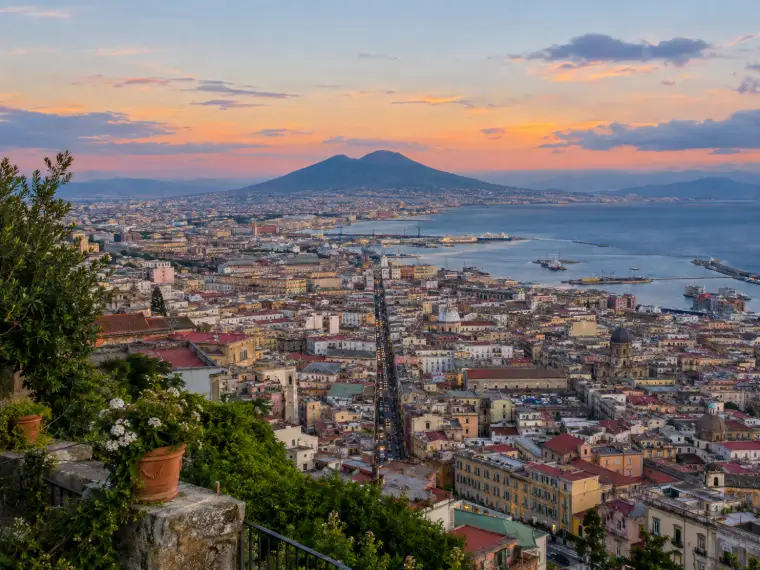
Walking along the decumanus, you see a narrow street between high walls, and the name doesn’t mean anything. From the hill, you see a cut: a continuous line crossing the dense fabric of the historic centre without deviating, with the two parallel streets of via dei Tribunali and via dell’Anticaglia just beyond. That line is the lower decumanus, and it’s why Neapolitans named the street as they did. The rest of the story is in why it’s called Spaccanapoli.
How to get up
The most direct route from the historic centre is the Montesanto funicular: you take it at Montesanto station, which is a short walk from the decumanus, and get off at Morghen. From there, you continue on foot uphill to the Certosa di San Martino and its belvedere. It’s not a half-day trip: counting the climb, stop, and descent, allow two or three hours. The other useful stations and connections are in how to get there.
What you recognise from up there
The first thing is the line. The second is the contrast between the historic centre, compact and regular in its grid, and the rest of the city, which climbs and frays. From that height, you also understand why the layout is traditionally traced back to the Hippodamian model: the parallels and perpendiculars are visible to the naked eye, without needing a map. If you’ve already taken the walk, you recognise the spots where you stopped; if you haven’t yet, go up first and then descend to walk knowing where you’re going.
Before or after the walk
What works
- Before: descend into the street already knowing the geometry of the historic centre
- Before: you understand the name instead of having to take it on faith
- After: you recognise the squares and bell towers you’ve just seen up close
- After: it neatly rounds off a day started on the decumanus
What to know
- It’s a two- or three-hour detour, not a ten-minute diversion
- In haze, the line is much less distinct
- The last stretch is uphill, on foot
- No guided tour of the historic centre goes there: you do it on your own
The time and effort involved
The Montesanto funicular covers most of the elevation, but the last stretch to the Certosa is on foot and uphill, which isn’t trivial if you have tired knees or small children. Counting the wait for the funicular, the climb, the stop at the belvedere, and the return, half a day is gone. That’s why I keep it separate from the walk on the decumanus instead of squeezing it in: two short programmes done well, not one long one done in a rush. The total times are in how much time you need.
If you can’t go up
You can still understand it by looking at a map of the historic centre before hitting the street. The three parallel lines of the decumani are immediately visible, and the cross streets cut them at regular intervals; from there, the nickname no longer seems like an exaggeration. It’s not the same as being on the belvedere, but it’s enough to avoid walking two kilometres wondering what was supposed to be split. The stops to see on the ground are in what to see.
When the view is best
With clear air, which in Naples often means after a day of wind or rain. The late afternoon light comes at an angle and draws shadows into the street’s crevice, which is what makes the cut readable; at midday in summer, haze flattens everything. On clear winter days, the view is the best of the year. The general calendar is in when to go, and it also applies to the climb: early morning or late afternoon, never at peak tourist time.
Don’t expect a sign saying “Spaccanapoli” on the belvedere. Look for the row of rooftops that breaks in a straight line at the level of the historic centre: that’s the street. It helps to have already walked it, or at least to have checked where it runs.
The full itinerary, if you have a day
Morning on the decumanus, with the interiors before the churches close at midday; lunch; afternoon at Montesanto, funicular, Certosa, and belvedere with the fading light. It’s how I take visitors seeing me for the first time, and it works because the two halves explain each other. The morning stops are in what to see, the timings in how much time you need. If you have two days, you can reverse the order and go up the first afternoon: you arrive on the decumanus the next day already knowing where you’re walking, and that’s the version I prefer.
Frequently asked questions
How do you see Spaccanapoli from above?
From the belvedere of the Certosa di San Martino, on the Vomero hill. You go up with the Montesanto funicular to Morghen and continue on foot. It’s the view that gave rise to the name: why it’s called Spaccanapoli.
How much time do you need to go up to San Martino?
Between the climb, the stop at the belvedere, and the descent, two or three hours. It’s best to keep it as a separate half-day, not to squeeze it into the walk on the decumanus.
Is there a guided tour that takes you to the belvedere?
Tours of the historic centre stay on the decumanus and via dei Tribunali: you go up to the belvedere on your own. What the tours include is explained in all tours.