San Gregorio Armeno: the nativity street, which is not Spaccanapoli
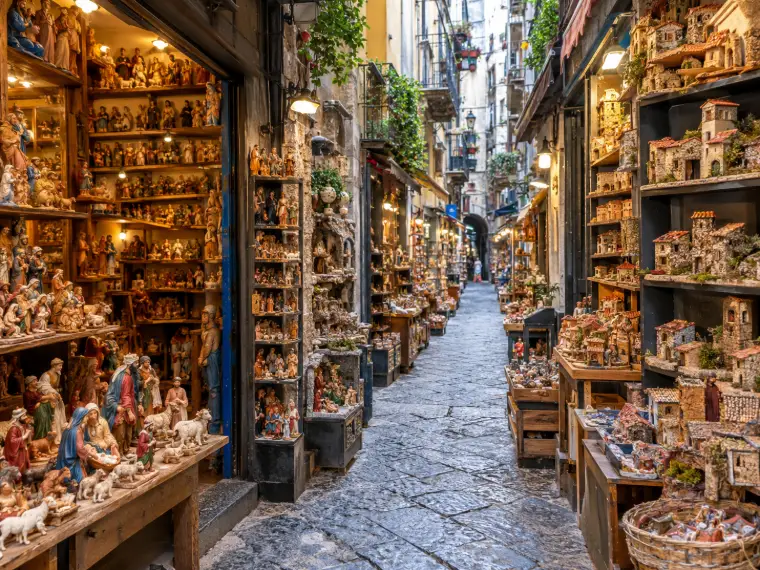
Why it’s not Spaccanapoli
Because it’s perpendicular. Spaccanapoli runs from west to east; San Gregorio Armeno rises from Spaccanapoli towards via dei Tribunali, and you can walk its entire length in a few minutes. It’s the most common mistake I hear: people arrive, photograph the nativity figures, go home, and say they’ve walked on Spaccanapoli. They’ve walked on one of its side streets. I explain the geometry of the three parallel streets and the side streets in why it’s called Spaccanapoli.
The church and the bell tower that spans the street
The church was founded around 930 on a temple dedicated to Ceres and was only named after San Gregorio Armeno in 1205. The first thing you notice when walking is the bell tower: it spans the street like a bridge, connecting the two convents on either side. It’s the spot where everyone raises their phone, and it’s also where the street gets congested, because everyone stops in the same square metre.
Nativity scenes aren’t just a December thing
The workshops are artisan studios and operate twelve months a year. In March or June, the street is the same, with the same goods and without the crowds: you see the nativity figures being made, the terracotta still raw, the tool benches. From November to 6 January, everything changes: you walk shoulder to shoulder, and at certain times you move one step at a time. Those coming for the artisans and not the Christmas atmosphere would do better to come out of season.
When to go
Early morning, always. In season, if you can, on a weekday. In the middle of December, the worst time is weekend afternoons, when even Neapolitans come to buy a new nativity figure. Out of season, the time matters less, but the workshops follow the rhythms of a workshop, not a shop. The full schedule is in when to go.
What works
- Genuine craftsmanship, not just souvenirs: you see the pieces being made
- It’s short and fits into any tour of the historic centre
- The bridge-like bell tower and the church are worth the detour
- Open and lively all year round
What to know
- From November to 6 January, progress is slow
- Scooters still pass through the narrow section
- The figurines of famous characters take up the best stalls
- It’s not Spaccanapoli: on its own, it’s not enough to say you’ve seen the decumanus
What you actually buy
Two worlds coexist in the workshops. One is that of handmade nativity figures and accessories: terracotta, fabric, iron, pieces that you buy one at a time and add over the years. The other is that of figurines of famous characters of the moment, which take up the most visible shop windows because that’s what people photograph. If you’re interested in the first world, go in and ask: almost all the stalls have a workshop behind them, and they’ll gladly explain the difference between a hand-modelled piece and a moulded one. It’s the same reason why it’s worth coming out of season, when there’s time to talk.
How to behave in the workshops
Ask before taking photos. It seems obvious, but it’s not: many enter with their phones already on and film the artisan at the bench as if they were a diorama. A simple word is usually enough, and the answer is almost always yes, often accompanied by an explanation that’s more valuable than the photograph. In small workshops, only a few people can enter at a time, because space is limited. And if you buy, don’t haggle like at a market: here, the person who made the piece is almost always in front of you, and the work on the terracotta is visible to the naked eye. Two or three good questions are worth more than any negotiation.
How it fits into the rest of the walk
It’s exactly halfway along the classic route, so it’s naturally included: from the decumanus you go up, reach piazza San Gaetano and via dei Tribunali, and from there you can continue towards the Duomo or go back down. Almost all guided tours of the historic centre include it with a stop of about twenty minutes. The stops for each one are in all tours, and the rest of the sights on the decumanus are in what to see. Doing just this, without the decumanus and without via dei Tribunali, is the quickest way to go home having seen a tenth of the historic centre.
If you go in December with children, enter from via dei Tribunali and go down: you’ll be going with the flow and it’s less tiring. Other tips are in Spaccanapoli with children.
Frequently asked questions
Are San Gregorio Armeno and Spaccanapoli the same thing?
No. San Gregorio Armeno is a perpendicular side street that connects via dei Tribunali to Spaccanapoli. The lower decumanus is a different street, straight and flat: its ends are in where it starts and ends.
What is San Gregorio Armeno famous for?
For its nativity workshops, open all year round, and for the church’s bell tower that spans the street like a bridge between the two convents. The church was founded around 930 and named after San Gregorio Armeno in 1205.
When should you go to San Gregorio Armeno?
Early in the morning, and if possible on a weekday. From November to 6 January, you walk shoulder to shoulder; out of season, the workshops still operate and you see much more. Details in when to go.
How much time do you need to walk it?
Ten minutes to walk, half an hour if you stop to look at the workshops, much longer in December. On guided tours, the stop is usually around twenty minutes.