What to see in Spaccanapoli, stop by stop
The direction: from west to east
I always walk it the same way, from piazza del Gesù Nuovo towards via Duomo. It’s not a rule—it’s convenience: you start on the wide side, finish near the Cathedral and the metro, and the sequence of sights has an order that’s easy to remember. The decumanus continues beyond via Duomo, but that part is more residential and has less to see. If you want the exact endpoints, I’ve listed them in where it starts and where it ends.
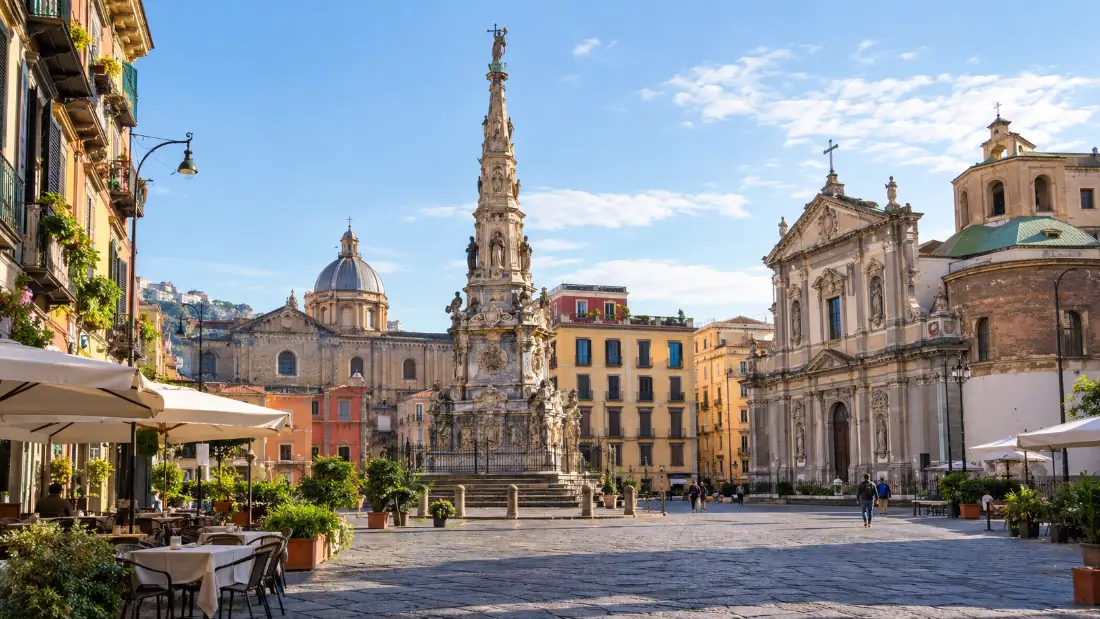
Piazza del Gesù Nuovo and the piperno facade
The church of Gesù Nuovo has a facade unlike any other church facade: diamond-pointed piperno ashlars, grey, which catch the light at an angle in the morning. It wasn’t originally a church. It was the palace of the Sanseverino princes, built in 1470, and that wall is what remains of the palace. At the centre of the square is the guglia dell’Immacolata. Entering the church costs nothing; it’s where most groups gather, so by ten o’clock the square is full.
Santa Chiara: the basilica and the cloister are two separate things
A few steps further on is the Santa Chiara complex. The basilica is fourteenth-century, commissioned by Roberto d’Angiò, and is wide and bare inside. The maiolica cloister is behind it and has a separate, paid entrance from the church: it’s the mistake I see most often, people entering the basilica, not finding the maiolica, and leaving convinced they’ve seen the cloister. The painted tiles on the pillars and benches are by Donato and Giuseppe Massa, 1739–1742, and are the reason I recommend that ticket.
Via Benedetto Croce and the doorways
Here the street changes name and narrows. It’s worth looking up and into the doorways: palazzo Filomarino, where Benedetto Croce lived, palazzo Marigliano, palazzo Pinelli. The courtyards open onto staircases you can’t see from the road. There’s nothing to pay and nothing organised: you look and move on.
Piazza San Domenico Maggiore
The square is one of the two or three points where the street breathes. In the convent of San Domenico, Tommaso d’Aquino taught and Giordano Bruno studied, which explains why every guide stops here for ten minutes. It’s also the right place for coffee, taken at the counter as they do here, or for a babà.
Cappella Sansevero, just off the street
The Cappella Sansevero isn’t on Spaccanapoli: it’s on via Francesco de Sanctis, an alley that starts at piazza San Domenico Maggiore. Inside is the Veiled Christ by Giuseppe Sanmartino, 1753, commissioned after the death of Antonio Corradini in 1752, and in the underground chamber, the two anatomical machines, traditionally attributed to Giuseppe Salerno around 1763. All commissioned by Raimondo di Sangro, seventh prince of Sansevero. Entry is by time slot, the rooms are small, and photography isn’t allowed inside. It’s the entrance worth planning ahead for: I discuss it in visit to the Cappella Sansevero.
Piazzetta Nilo and the Corpo di Napoli
A little further on, in largo Corpo di Napoli, is the statue of the god Nile, a reclining man that Neapolitans call the Corpo di Napoli. Next to it is Sant’Angelo a Nilo. It’s a four-metre-wide space, and people walk past without noticing it.
The intersection with San Gregorio Armeno
Then comes the nativity street. San Gregorio Armeno cuts across perpendicularly and climbs towards via dei Tribunali: it’s not Spaccanapoli, and it’s not part of Spaccanapoli—it’s another street that crosses it. The workshops operate all year, not just in December. I’ve written separately about what San Gregorio Armeno is and when to go, because between November and 6 January, you walk shoulder to shoulder.
What you pay for and what you don’t
You don’t pay for
- The street, always, at any time
- The facade and the church of Gesù Nuovo
- The basilica of Santa Chiara
- Piazza San Domenico Maggiore and the Nile statue
- Browse the workshops of San Gregorio Armeno
Payment required
- The maiolica cloister of Santa Chiara
- The Sansevero Chapel and the Veiled Christ
- The underground, which you visit with an escort
- A guide to explain what you are seeing
Churches close at midday, roughly between 12:30 and 4:30 pm. If you only have a morning, visit the interiors before lunch and save the shop windows and alleys for the afternoon. The full schedule is in when to go.
With a guide or on your own
The street is easy to walk alone: it’s straight, public, and you can’t get lost. What changes with a guide are two things: the narrative and pre-booked tickets. Tours of the historic centre last about two and a half hours and include entry fees in the route, so you don’t queue twice. If you’re deciding, I’ve listed the pros and cons in is it worth it and the full comparison in all tours.
Frequently asked questions
What can you see on Spaccanapoli in a day?
In a full day, you can visit Gesù Nuovo, the cloister of Santa Chiara, San Domenico Maggiore, the Sansevero Chapel, Piazzetta Nilo, San Gregorio Armeno, and the Duomo, at a relaxed pace with the midday break when churches close. If you have less time, see how much time you really need.
Do you have to pay to enter Spaccanapoli?
No. It’s a public street, open at all hours, with no ticket or turnstiles. You only pay for the interiors: the cloister of Santa Chiara, the Sansevero Chapel, and the underground. Details on what costs are in how much it costs.
What should you not miss?
If you can only choose one, it’s the Veiled Christ in the Sansevero Chapel. Entry is timed, and the rooms are small, so it’s best to have your ticket already or book it as part of a guided tour.
Where is the best place to start?
From Piazza del Gesù Nuovo, arriving from Dante metro station or via Toledo, and walking towards via Duomo. Directions to both ends are in how to get there.