Why it’s called Spaccanapoli
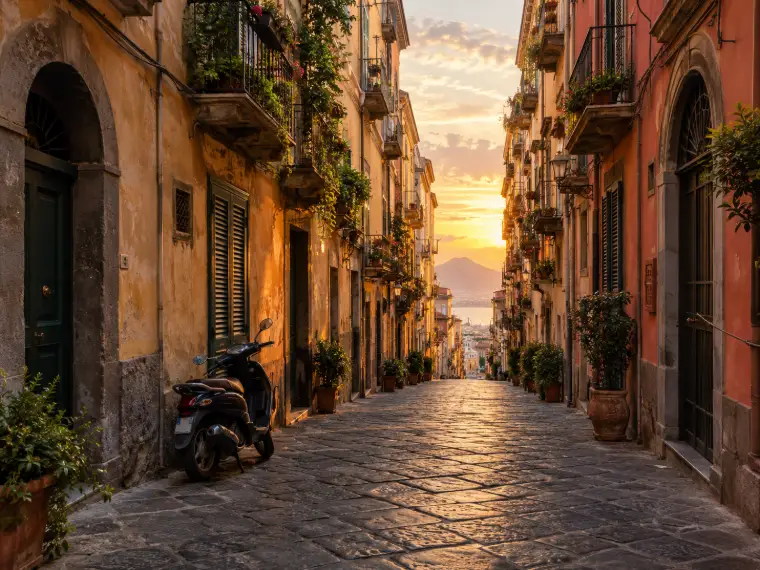
In Neapolitan, *spaccare* means to split
The verb isn't metaphorical. Seen from the ground, the street is a narrow road like many others; seen from above, it's a crack running from one side to the other of the old centre without curves. From up there, the city seems split in two by a clean cut, and the name describes exactly that. Those who have never seen it from above find the name exaggerated: that's normal, and it’s solved by going up. I explained where and how in seeing Spaccanapoli from above.
Why there’s no sign
Because that’s not the official name. The street is called, along its route, via Pasquale Scura, via Benedetto Croce, via San Biagio dei Librai, via Vicaria Vecchia, via Forcella, via Giudecca Vecchia, via Ottavio Tupputi. Seven different signs for a single line. This creates the scene I see every week: someone with a phone in hand asking where Spaccanapoli is while standing in the middle of Spaccanapoli. The two ends and the full sequence are in where it starts and where it ends.
Beneath the nickname lies the lower decumanus
The route wasn’t born by chance and isn’t medieval. It’s the lower decumanus of Roman Neapolis, which in turn follows a plateia of the Greek city; the grid layout of the old centre is traditionally traced back to the Hippodamian model, with parallel streets and perpendicular crossings. That’s why, in a city that has almost nothing straight, this street is straight: it follows a line drawn over two thousand years ago.
The three decumani
The parallel lines are three. The upper decumanus runs through the area of via dell’Anticaglia, the main decumanus is via dei Tribunali, and the lower decumanus is Spaccanapoli. The cross streets connect them from hill to valley, and the most famous is via San Gregorio Armeno, which links via dei Tribunali to Spaccanapoli and which many mistake for Spaccanapoli itself. It isn’t: it’s perpendicular, not parallel.
Why it’s famous
For three reasons combined. The first is the cut: a two-kilometre line within a historic centre that has been a UNESCO World Heritage site since 1995 and is the largest in Italy, about 17 km², of which about 10.2 km² are in the protected area. The second is the density: on the monumental kilometre, between piazza del Gesù Nuovo and via Duomo, you find Gesù Nuovo, Santa Chiara, San Domenico Maggiore, piazzetta Nilo, and a short walk away the Cappella Sansevero with Giuseppe Sanmartino’s Veiled Christ, 1753. The third is that all this is on a street where people live, hang out laundry, and go shopping. The stops in order are in what to see.
The squares the street crosses
Another way to understand the cut is to see where the line widens. There are three points: piazza del Gesù Nuovo, with the piperno façade and the spire of the Immacolata; piazza San Domenico Maggiore, in front of the convent where Thomas Aquinas taught and Giordano Bruno studied; piazzetta Nilo, that is largo Corpo di Napoli, a small widening of a few metres with the statue of the Nile god. Between one and the other, the street narrows again between the walls. It’s this alternation that gives the walk its rhythm, and from above it reads like a series of small breaths along the same line.
The two most common confusions
The first: San Gregorio Armeno. It’s the street of nativity scenes, cuts perpendicularly and climbs; many return home convinced they’ve seen Spaccanapoli when they’ve seen a cross street just a few hundred metres long. The second: the Quartieri Spagnoli, which lie uphill from via Toledo, on the opposite side of the decumanus, and are a grid of alleys on a slope created in the sixteenth century to house Spanish garrisons. Two different things, a few minutes’ walk from each other.
If you want to understand the name in ten minutes, look at a map of the old centre before going down to the street: the three parallel lines of the decumani are visible at a glance, and from then on you won’t get lost.
Who tells you about it while you walk
This is material for a guide, not a sign: the Greek and Roman stratification beneath the buildings isn’t visible, it’s explained. The tours on the origins and legends of the old centre last about two and a half hours and start from piazza Bellini; I wrote about them in the review of the origins and legends tour and compared them with the others in all tours. If instead you just want the name and prefer to walk on your own, the street doesn’t ask anything of anyone: it’s public, open at any time and has no entrance to pass through.
Frequently asked questions
Why is Spaccanapoli called that?
Because seen from above, from the belvedere of the Certosa di San Martino, it seems to split the old centre in two. The name is a popular nickname: the official toponym doesn’t exist. The panoramic point is in seeing Spaccanapoli from above.
Why is Spaccanapoli famous?
For the straight two-kilometre cut through the largest historic centre in Italy, a UNESCO site since 1995, and for the density of things that overlook the kilometre between Gesù Nuovo and via Duomo. The list in order is in what to see.
Are Spaccanapoli and the lower decumanus the same thing?
Yes. Spaccanapoli is the popular name for the lower decumanus of Roman Neapolis. The other two are the main decumanus, that is via dei Tribunali, and the upper one, in the area of via dell’Anticaglia.
Who gave the street its name?
No one in particular: it’s a name in use, born from the observation from above and remaining in Neapolitan speech. That’s why it doesn’t appear on signs and has no birth date.